Research and development
Carbon, energy and materials, studied as one system.
The research programme is organised into seven lines. Five address a field of application and two work across the whole portfolio: simulation and modelling, and life cycle assessment.
The programme
From the life cycle of CO2 to the materials that make it useful.
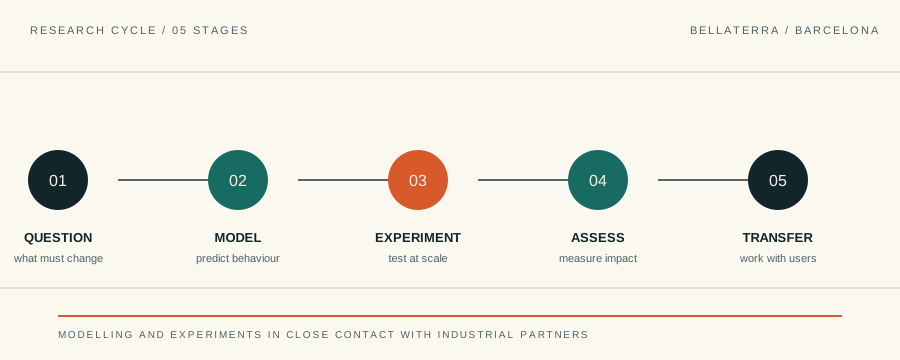
The centre's work begins with a practical question about a gas, a material or a process. That question might be about how strongly a solid binds CO2, how a catalyst behaves at an interface, or whether a new food packaging atmosphere extends shelf life without undesirable effects.
Answers are sought through a combination of modelling and experiment. The two are treated as partners rather than alternatives: a model can identify the most promising material, and an experiment can reveal where the model is wrong. The same logic applies at pilot scale, where process models are tested against measurements.
The programme also includes an explicit assessment of environmental performance. New processes are examined across their life cycle so that a local improvement is not achieved by shifting the burden elsewhere.
At a glance
- Research lines
- Seven, five vertical and two horizontal
- Methods
- Modelling, synthesis, characterisation and pilot work
- Assessment
- Life cycle thinking across projects
- Partners
- Industry, universities and public research bodies
Seven lines
Each line has a distinct question. The methods overlap.
Projects rarely sit inside a single line. A study of CO2 capture may draw on simulation, gas reactivity and life cycle assessment at the same time.
CO2 utilisation
Capture, preparation and use of CO2 in materials and industrial processes.
02Bioenergy
Energy and added value products from biological residues.
03Materials for energy
Materials for conversion, storage and catalysis.
04Food preservation
Gas based protection of food with reduced reliance on additives.
05Water treatment
Cleaner industrial and leisure water through applied process work.
06Simulation and modelling
Molecular and process models that make experiments more decisive.
07Life cycle assessment
Quantifying the net environmental gain of a process or product.
Funded work and publication.
Research is supported by national and European programmes, by industrial partnerships and by the centre's own resources. Funded projects provide a structure for collaboration and a clear set of deliverables; publication makes the results available to the wider community.
The centre's output includes journal articles, conference contributions and project reports. The publications page describes the main themes and the journals in which the work has appeared.
Research funding
External resources, opening in a new tab.