Can CO2 become a resource?
Capture is only one part of the problem. We study what can be done with CO2 after it is captured: new solvents, mineralisation routes, supercritical processes and materials that hold or transform it.
CO2 utilisationMATGAS Review / Field notes 2026
Materials and gases, studied together. An independent centre for CO2, energy and clean processes.
Cover story / Carbon, materials and energy
MATGAS studies the full life cycle of CO2, from capture and conversion to safe use, alongside energy materials, clean water and food preservation. We combine molecular modelling with laboratory work and bring both into conversation with industry.
In this issue
An economic interest group formed by
Features / what we work on
They are practical questions about carbon, energy and resources. Answering them requires chemistry, physics, engineering and a clear view of the systems in which a new process has to operate.
Capture is only one part of the problem. We study what can be done with CO2 after it is captured: new solvents, mineralisation routes, supercritical processes and materials that hold or transform it.
CO2 utilisationHydrogen, batteries, photovoltaics and catalysts depend on materials that behave predictably at surfaces and interfaces. We model them, make them and measure them.
Materials for energyWater treatment, food preservation and process intensification are routes to lower impact. We test them at laboratory and pilot scale, then assess the net environmental effect.
Water treatmentContents / research lines
Five lines address a field of application. Two work across all of them: simulation and modelling, and life cycle assessment.
Capture, preparation and use of CO2 in industrial processes and materials.
02Recovering energy and added value products from biological residues.
03New materials for energy conversion, storage and catalysis.
04Gas based protection of packaged food, with less reliance on additives.
05Technically viable routes to cleaner industrial and leisure water.
06Molecular and process models that make experiments more decisive.
07Quantifying the net environmental gain of a new process or product.
Field notes / laboratories
Our facilities support modelling, synthesis, characterisation and scale up. Each space has a defined role, and projects often move between several of them.
Editor's note
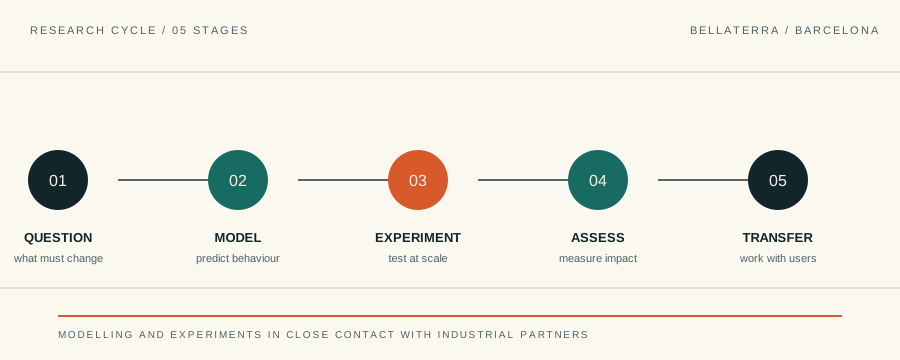
Many research questions are too complex for a single technique. A model can narrow the field of possible materials; an experiment can test whether the model has captured the right physics. The centre is organised so that the two can respond to each other quickly.
That way of working also shapes our partnerships. We begin with a real process or material problem, agree what a useful result would look like, and keep the assessment of environmental benefit in view from the start.
Dispatches / from the archive
The news archive records research findings, project milestones and people. It is a working record rather than a live feed.
MATGAS received the 2014 National Award for the Public Private Partnership in Research and Innovation, given by the Catalan Foundation for Research and Innovation.
Read the noteA study with UAB and UAM researchers found that ultrastable indomethacin glasses depart from the quantum tunnelling states usually seen in amorphous solids at low temperature.
Read the noteThe H2TRUST consortium was formed to examine the sustainability and safety of hydrogen as it enters wider use in European cities and industrial systems.
Read the noteWe work with companies, public research groups and early career researchers. A first conversation can be about a material, a process, a measurement or a project idea.